

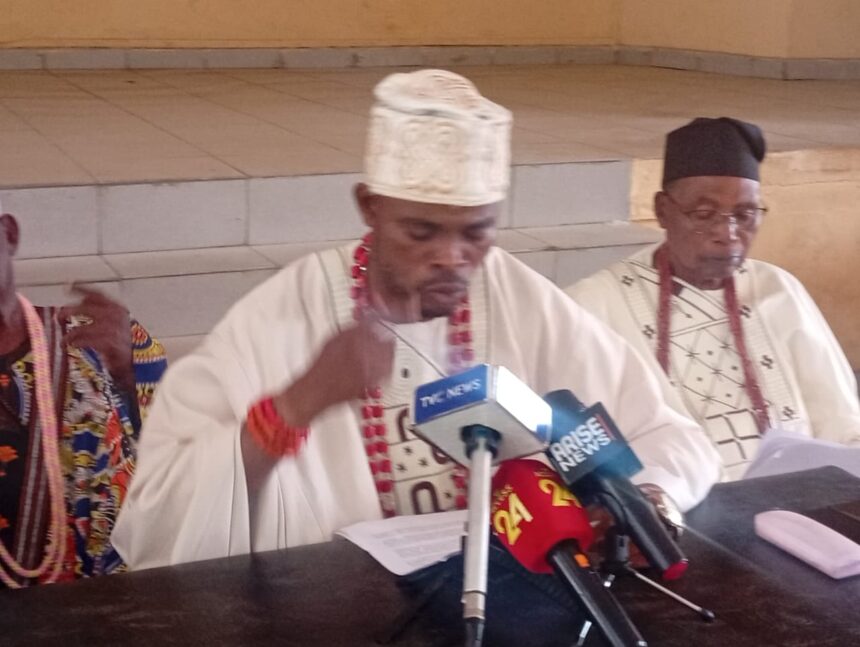
Traditional stakeholders in Ife North Local Government Area have raised serious concerns over the alleged diversion, withholding and non-transparent disbursement of the statutory five per cent allocation meant for traditional institutions and chieftaincy affairs within the council area.
The alarm was raised during a press conference addressed by the Lodifi of Ipetumodu, Chief Orosanya Kehinde, who spoke on behalf of concerned chiefs, Baales, elders and custodians of cultural heritage in the local government.
The stakeholders said the briefing became imperative amid mounting complaints over the administration of the allocation under the framework of local government financial autonomy.
According to them, traditional institutions across Ife North have continued to suffer neglect despite the Supreme Court-backed constitutional recognition of local government autonomy.
“This gathering has become necessary in view of the growing concerns, complaints and disturbing revelations surrounding the alleged diversion, withholding, neglect and lack of transparency in the management and disbursement of the statutory five per cent allocation reportedly meant for traditional institutions, Baales and chieftaincy affairs within Ife North Local Government,” Chief Orosanya said.
The group stressed that traditional rulers, Baales and chiefs remain critical grassroots institutions with responsibilities that include conflict resolution, cultural preservation, security support and community development.
“It is therefore deeply disturbing, unfortunate and unacceptable that despite the clear constitutional position and the ongoing implementation of local government autonomy across the country, traditional institutions within Ife North Local Government have allegedly continued to suffer financial neglect while funds reportedly designated for traditional and chieftaincy administration are either withheld, selectively distributed or inadequately accounted for,” the statement added.
The stakeholders also expressed reservations over reports that parts of the allocation were allegedly subjected to external control and disbursement arrangements outside the officially recognised administrative structure of the council.
According to the group, the concern centres on ensuring that the allocation is transparently managed and equitably utilised for the benefit of all recognised traditional institutions within the local government.
They further alleged that some communities were favoured in the disbursement process while others, including Ipetumodu and Moro, were allegedly sidelined because they currently lack substantive monarchs.
The stakeholders described the development as one that raises serious constitutional, administrative and financial concerns.
“The allocation in question is meant for the collective traditional, Baaleship and chieftaincy institutions within Ife North Local Government Area and should never be subjected to selective distribution, favoritism or arbitrary discretion lacking transparency and accountability,” the statement read.
The chiefs also condemned alleged irregular payment procedures, including claims that some vouchers and payment authorisations were informally handled.
“In particular, we strongly condemn the alleged practice whereby vouchers or payment authorisations are reportedly being issued in informal manners, including instances allegedly written in pencil,” the group stated.
The stakeholders further alleged that some traditional functionaries reportedly receive as low as ₦1,000 monthly despite the existence of allocations designated for traditional institutions.
They consequently called on the chairman of Ife North Local Government Area, the Osun State Government, Ministry of Local Government and Chieftaincy Affairs, finance authorities and relevant oversight agencies to clarify the administration and disbursement of the allocation.
The group demanded full transparency on all allocations received, public disclosure of beneficiaries and a thorough investigation into any alleged withholding or mismanagement of the funds.
According to the stakeholders, the matter transcends politics and touches on fairness, institutional dignity and the preservation of traditional heritage within the local government.