

By Teslim Adegboyega, Awau Adegoke
Before the sun climbs over the roofs of many cities and campuses in Nigeria, discarded pet bottles, sachets of “pure water” flatten under footpaths, transparent bottles roll lazily along gutters, and food waste steam quietly in bins, already tells a global story. This is the story of many cities and campuses in Nigeria. Essentially, what looks like campus litter is, in fact, a fragment of a much larger crisis, one that the United Nations Environment Programme (UNEP) describes as one of the defining environmental challenges of the 21st century.
Globally, the world generates more than 2.01 billion tonnes of municipal solid waste annually, according to the World Bank’s What a Waste 2.0 report. If current consumption and disposal patterns persist, that figure is projected to rise to 3.4 billion tonnes by 2050, with low- and middle-income countries contributing the fastest growth. UNEP warns that poorly managed waste accelerates climate change, contaminates water bodies, threatens biodiversity and disproportionately harms vulnerable populations living near dumpsites and landfills.
Nigeria sits squarely within this global emergency. Federal estimates and development partners place Nigeria’s annual solid waste generation at over 32 million tonnes, with plastics forming a rapidly expanding component due to urbanisation, sachet water consumption and single-use packaging. The World Bank notes that less than 30 per cent of Nigeria’s waste is formally collected, while recycling rates remain below 10 per cent, leaving the bulk of refuse to open dumping, burning or drainage disposal. UNEP has repeatedly flagged Nigeria as a country where weak waste governance intersects with rising plastic consumption to produce severe environmental and public-health risks.
In south-western Nigeria, Osun State reflects this national pattern in miniature. Studies cited by state agencies and environmental researchers show that organic waste and plastics dominate urban refuse streams, with limited infrastructure for separation at source. The Osun State Waste Management Agency (OWMA) has acknowledged that waste sorting is largely informal and that recycling depends heavily on scavengers, itinerant buyers and small-scale aggregators who bridge the gap between households and recycling industries. It is within this informal but resilient ecosystem that the circular economy quietly operates.
The circular economy, as defined by UNEP and the European Commission, rejects the traditional “take-make-dispose” model. Instead, it promotes a system where materials are kept in use for as long as possible, waste is designed out of the system, and discarded items are recovered, processed and returned into production cycles. In Nigeria, this model is not driven by policy alone; it survives through everyday improvisation and through hands that pick, sort and sell what others throw away.
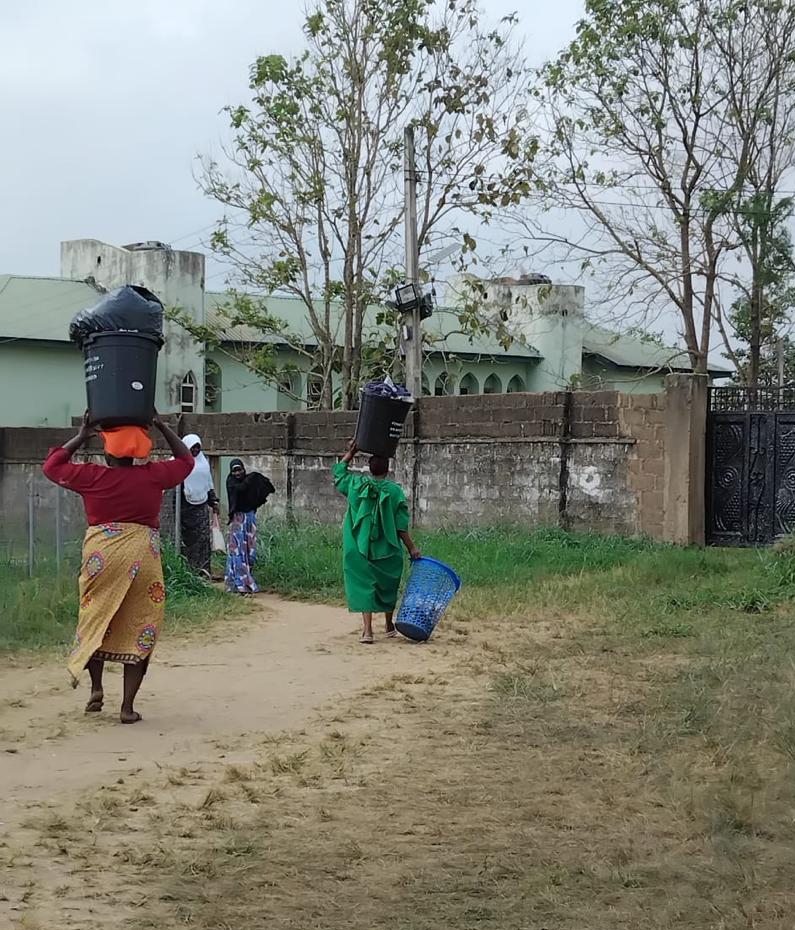
At Fountain University, Osogbo, the logic of the circular economy unfolds not in policy documents but along office corridors and shaded walkways. Facility Service Personnel, mostly women employed to clean offices, classrooms and surroundings, move through the campus daily, sweeping up the detritus of academic life. Mixed into their routine tasks is an informal but deliberate act of recovery where plastic bottles are separated from food waste and nylon, stored, weighed and eventually sold.
The buyers arrive periodically in trucks and shuttle buses. Bottles and cans are poured onto scales, negotiated over, and priced usually between ₦800 and ₦1,200 per kilogramme, depending on market demand. From there, the materials travel onward to sorting yards, where they are washed, shredded or compacted before being sold to recycling plants. According to industry reports cited by UNIDO’s circular economy programmes in Nigeria, recovered plastics are processed into pellets used in manufacturing new bottles, containers, fibres and construction materials, thus, reducing demand for virgin plastic and lowering carbon emissions.
For the workers, however, the process is less abstract and more personal. Hameed Fawzat, one of the Facility Service Personnel, speaks matter-of-factly about what passes through her hands each day. “Waste such as sachets of pure water, nylon, leftover food and plastic bottles are what we handle on a daily basis,” she explained. Plastic bottles, she said, are the only items that reliably bring in money. “We derive a small amount of money from plastic bottles after separating them from other waste. The bottles are sold, and the money is used mainly for transportation fares.”
That income, she noted, has become increasingly uncertain. “Previously, the income from selling the bottles was reasonable, but it has reduced significantly compared to before,” Fawzat added. Still, the practice persists, driven by necessity and awareness. “If we do not collect and sell these bottles, those who pick waste from the dump site will also sell them and earn money. This is one of the reasons we started selling recyclable waste.”
Yet, the work is done without formal guidance. Across Nigeria, UNEP has emphasised that waste segregation at source is critical to effective recycling, but remains poorly implemented. At Fountain University, separation is learned informally. Lawal Jelilat said there was no structured training. “We were not formally taught how to separate waste; we rely on our own knowledge and experience,” she noted. What ends up in the bins often complicates their task. “Some students pour garri or custard into the bins, while others dispose of unwashed menstrual pads.”
For Olayiya Latifa, the hazards are even more immediate. Waste liquids, by-products of mixed disposal, often spill during transportation. “We were not properly taught how to separate waste; rather, we learned from older and more experienced cleaners,” she highlighted. “Sometimes, the dirty water that drains from the waste pours on us when we carry it on our heads.”
Their experiences typify broader findings by the World Bank and UNEP, which note that informal waste workers across developing countries operate at the frontline of recycling while bearing disproportionate health and safety risks. Yet these same workers are recognised as essential actors in the circular economy, recovering materials that formal systems fail to capture.
At Fountain University, the campus becomes a micro-laboratory of what Nigeria’s waste future could look like. Here, discarded bottles are not merely refuse; they are commodities, livelihoods and environmental interventions. In a country where millions of tonnes of waste remain unmanaged, the quiet labour of Facility Service Personnel demonstrates how circularity already exists, unrecognised, unsupported, but functional.
As Nigeria and states in the country explore waste-to-wealth initiatives, recycling plants and extended producer responsibility schemes, the lesson from this campus is clear. The circular economy is not waiting to be invented. It is already happening. It is one bottle at a time, in the hands of workers who sweep, sort and survive within the margins of a global environmental crisis. Their work may not appear in policy blueprints, but it reflects the lived foundation of the circular economy in Nigeria.