

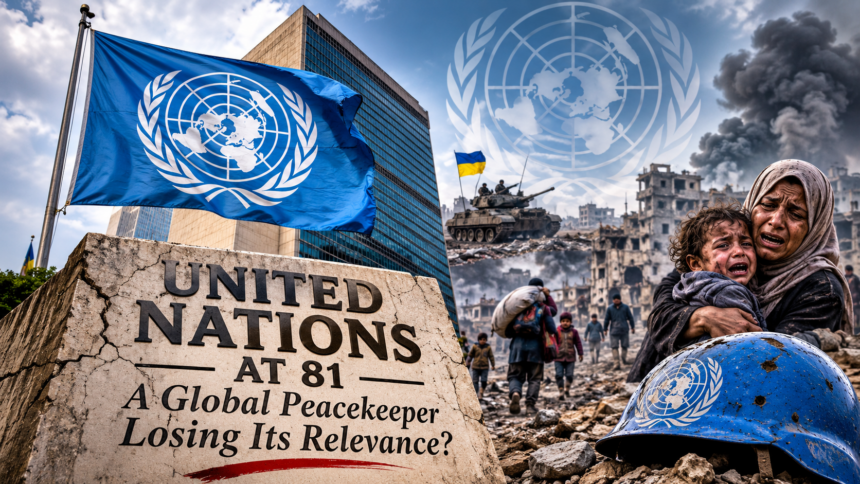
When the United Nations (UN) was established in 1945, following the devastation of the Second World War, the world was united by a common aspiration: to prevent another global catastrophe and save succeeding generations from the scourge of war. Its founding principles were anchored on the promotion of international peace and security, respect for human rights, peaceful resolution of disputes and cooperation among nations. More than eight decades later, however, the world appears to be asking an uncomfortable question: Is the United Nations still capable of fulfilling the purpose for which it was established, or is it gradually becoming an institution living on its past glory?
The question is not without justification. From the protracted Russia-Ukraine war to the devastating humanitarian situation in Gaza, the persistent instability in Yemen and the escalating confrontation involving Iran, Israel and the United States, the international community continues to witness conflicts that threaten lives, undermine national sovereignty and destabilise the global economy. In several instances, the UN has issued condemnations, facilitated diplomatic engagements, passed resolutions and called for ceasefires. Yet, the destruction continues, civilians remain vulnerable and the prospects of lasting peace appear increasingly uncertain.
Perhaps nowhere is this contradiction more glaring than in Gaza. Despite international diplomatic interventions and ceasefire arrangements, the Palestinian population continues to endure an appalling humanitarian situation. Reports of renewed attacks, civilian deaths, destruction of infrastructure and restrictions affecting humanitarian operations raise serious questions about the capacity of the international community to protect vulnerable populations. What is particularly troubling is the apparent gap between international declarations of concern and the practical protection of human lives. A ceasefire should represent a genuine cessation of hostilities, not merely a diplomatic announcement that exists alongside continuing violence and civilian suffering.
The Russia-Ukraine war presents another significant challenge to the credibility of the United Nations. Since Russia launched its full-scale invasion of Ukraine in February 2022, diplomatic efforts and international resolutions have failed to produce a lasting settlement. The war has resulted in enormous human suffering, displacement, destruction of infrastructure and economic disruptions extending far beyond Europe. More importantly, it has exposed the difficulty of holding a powerful state accountable when that state occupies a permanent seat on the very Security Council responsible for maintaining international peace and security.
The situation in Yemen, involving the internationally recognised government, the Houthi movement and regional powers, equally demonstrates the complexity of contemporary conflicts. Although diplomatic initiatives have periodically reduced hostilities, the underlying political and humanitarian problems remain unresolved. Similarly, the confrontation involving Iran, Israel and the United States illustrates how regional rivalries can rapidly assume global economic and security implications. Threats to shipping routes, energy infrastructure and international trade have consequences for countries far removed from the immediate theatres of conflict. For developing economies, particularly those heavily dependent on imported goods and vulnerable to fluctuations in global energy prices, these conflicts can translate into higher living costs, inflation and economic uncertainty.
At the centre of the UN’s apparent inability to decisively address these challenges is the structure of its Security Council. The five permanent members, namely the United States, Russia, China, the United Kingdom and France, possess veto powers that enable any one of them to block substantive resolutions, regardless of the position of the majority of Council members. This arrangement, inherited from the geopolitical realities of the Second World War, has become one of the greatest contradictions in contemporary international governance.
How can an organisation effectively enforce international peace and security when some of the most powerful countries can prevent action against themselves or their strategic allies? How can the principle of sovereign equality be meaningfully defended when the influence of a handful of nations determines the extent to which international decisions can be implemented? These questions expose the institutional limitations of a system that appears to demand compliance from weaker nations while providing exceptional privileges to the most powerful.
The problem, therefore, goes beyond the failure of individual diplomatic interventions. It reflects a structural weakness in the international system. The UN is expected to function as the principal guarantor of collective security, yet its ability to act is frequently constrained by the competing political and strategic interests of its most influential members. Consequently, international law sometimes appears stronger in its application to less powerful countries than in situations involving major global powers.
Nevertheless, declaring the United Nations completely irrelevant would be an unfair assessment of its contributions to humanity. Through its agencies and programmes, the organisation has played significant roles in humanitarian assistance, refugee protection, global health, education, poverty reduction, development cooperation and the promotion of human rights. Its peacekeeping operations, despite their limitations, have also contributed to stabilisation efforts in several conflict-affected countries. For millions of vulnerable people, the UN remains an important source of humanitarian support and international advocacy.
However, humanitarian relevance should not be confused with effectiveness in preventing wars. An organisation may remain indispensable in delivering relief to victims of conflicts while simultaneously demonstrating serious weaknesses in preventing the conflicts that produce those victims. This distinction is central to understanding the present crisis of confidence in the United Nations.
The time has therefore come for a fundamental reconsideration of the organisation’s structure and operating principles. Security Council reform should be a priority, particularly the question of expanding permanent representation to accommodate regions such as Africa and Latin America, which remain inadequately represented in the highest decision-making body on international security. Africa, despite bearing a disproportionate share of the consequences of global political instability and armed conflicts, has no permanent seat on the Security Council. This is an imbalance that can no longer be justified by the geopolitical circumstances of 1945.
Equally important is the need to reconsider the exercise of veto powers, especially in situations involving mass atrocities, genocide and serious violations of international humanitarian law. The international community must also develop stronger mechanisms for ensuring compliance with binding resolutions and holding perpetrators of violations accountable, irrespective of their political or military influence.
Ultimately, the credibility of the United Nations will depend not on the number of resolutions it adopts or the frequency of its diplomatic statements, but on its ability to translate international consensus into meaningful action. The world does not need an institution that merely documents wars, condemns aggression and appeals for peace after thousands of lives have been lost. It needs an organisation capable of preventing conflicts, protecting civilians, promoting justice and ensuring that international law applies equally to all nations.
The greatest danger is that the international community may gradually become accustomed to wars, civilian casualties, territorial aggression and humanitarian disasters as ordinary features of global politics. When repeated violations attract little more than familiar expressions of concern, the very idea of a rules-based international order begins to lose its meaning.
At 81, the United Nations must confront a defining question about its future. Is it still fit for the purpose for which it was established, or has it become an institution whose historical achievements are increasingly overshadowed by its contemporary limitations? Its survival as a credible global institution may depend on how honestly and urgently it answers that question.
The world has changed considerably since 1945. The UN must change with it. Otherwise, an institution established to prevent another generation from experiencing the horrors of war risks becoming a witness to the very tragedies it was created to prevent.